

SaaS Has Replaced Your Server Room. Has Your Security Kept Up?
Cybersecurity threats pose a significant risk to small and mid-sized businesses (SMBs), with 43% of cyberattacks targeting these organizations. Furthermore, 60% of breached SMBs cease operations within six months. Software as a Service (SaaS) applications now underpin daily operations, replacing the traditional server room. This shift, alongside artificial intelligence (AI) at the network edge and platforms like Microsoft Teams serving as the virtual office, demands a fundamental re-evaluation of security strategies.
The Evolution of the Workplace and Technology
For decades, local servers housed critical applications and stored sensitive data, requiring high upfront costs and on-site expertise.
Software as a Service (SaaS) eliminated on-premise hardware maintenance by delivering applications online. Over 80% of businesses utilize at least one SaaS application, a figure projected to reach 85% by 2025.
Collaboration tools like Microsoft Teams now serve as the virtual office, while artificial intelligence (AI) operates directly at the network edge on endpoint devices. This requires local compute power while creating new security considerations beyond traditional network boundaries.
The Disappearing Security Perimeter
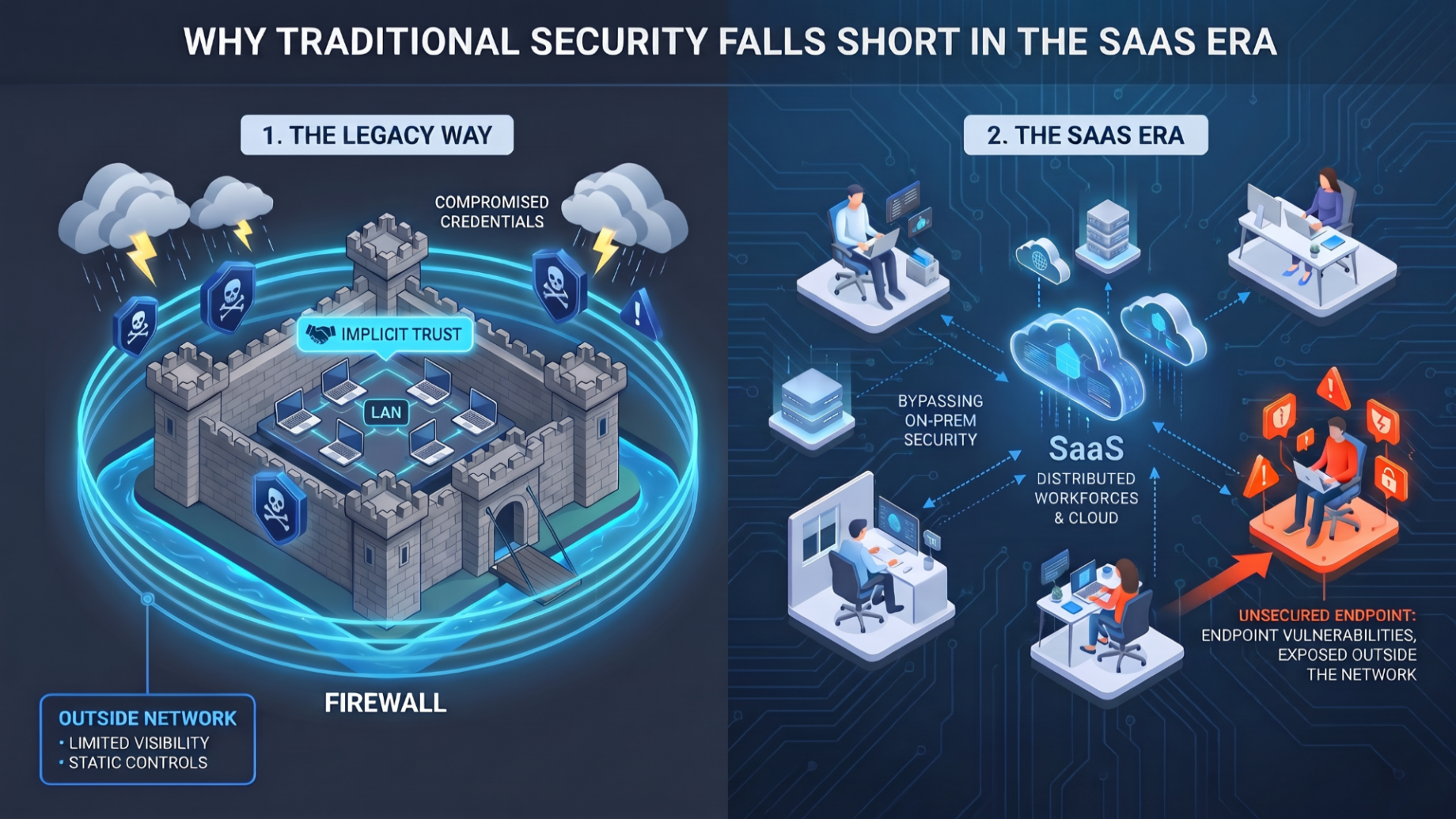
Traditional security relied on a defined network perimeter guarded by firewalls. The rise of SaaS and distributed workforces has dissolved this model. With employees accessing cloud applications from various locations and devices, a single network boundary is obsolete. Data is distributed across cloud services and endpoints, expanding the attack surface. In fact, 85% of Canadian SMBs have experienced at least one cyber incident in the past five years.
Why Traditional Security Falls Short in the SaaS Era
Legacy security solutions designed for on-premise infrastructure fall short due to key limitations:
- Implicit Trust: Traditional systems assume inside network activity is safe, leaving organizations vulnerable to compromised credentials.
- Limited Visibility: Dispersed SaaS applications make monitoring suspicious activity difficult.
- Static Controls: Legacy systems fail to adjust permissions based on request context, such as untrusted locations.
- Endpoint Vulnerabilities: While SaaS providers secure cloud infrastructure, businesses remain responsible for securing access and endpoint devices.
Unsecured endpoints operating outside corporate networks explain why one in three cyber insurance claims are denied.
The Path Forward: Embracing Zero Trust
Businesses must adopt a Zero Trust architecture based on the principle of “never trust, always verify.” Every user, device, and application must be authenticated and continuously validated before access is granted.
Core tenets include:
- Explicit Verification: Validating every request using identity, device health, location, and context.
- Least Privilege Access: Granting minimum access necessary for specific roles.
- Continuous Monitoring: Evaluating security posture continuously to revoke access if risk changes.
- Micro-segmentation: Isolating network zones to prevent lateral threat movement.
Implementing Zero Trust strengthens security, supports compliance, and enables secure cloud growth.
Redefining “Good IT” in the Cloud Era
Effective IT for Canadian small and mid-sized businesses must be secure, demonstrably compliant with regulations and insurance requirements, and flexible. Organizations need an IT partner capable of implementing modern security architectures that safeguard every device, user, and application across distributed environments.
Summary of Key Takeaways and Next Steps
Transitioning to SaaS applications offers operational flexibility but eliminates traditional security perimeters. With AI at the edge and platforms like Microsoft Teams defining the modern workspace, adopting Zero Trust architecture is essential.
Evaluate whether your security controls match your threat landscape. Review your posture, adopt Zero Trust principles, and partner with experts to protect digital assets and maintain business continuity.
Sources
- How Can Zero Trust Architecture Benefit Small Businesses? – Optimum.
- THE EVOLVING ROLE OF SAAS AND IT OUTSOURCING IN SMB IT SECURITY – Kaspersky.
- Canadian SMBs Face Rising Cyberattacks in 2025 – Employment Hero (CA).
- Zero Trust for Small Businesses: A Step-by-Step Guide for IT Directors – CompassMSP.
- 5 Key Benefits of Zero Trust Architecture for Businesses – The Swenson Group.
- What Is Zero Trust Architecture? Key Elements and Use Cases – Palo Alto Networks.
- 46 SaaS Industry Stats and Insights for 2024 and Beyond – UnoiaTech.
- 10 common challenges SMBs face when migrating to the cloud – Cloudtech.
- SaaS security for SMBs: A growing concern – Onsite Computing, Inc.
- 46 SaaS Industry Stats and Insights for 2024
- Small Business Cloud Security: Challenges & Best Practices – SentinelOne.
- ‘Don’t underestimate the threat:’ National cyber security program warns Canadian small businesses – BNN Bloomberg.
- Top 11 SaaS Industry Trends in 2024 – OurCrowd.
- 100+ SaaS Statistics : Best Adoption Facts, Usage & Trends – eSparkBiz.
- 60+ eye-opening SaaS statistics (2025) – Spendesk.
- SMB Cybersecurity Tips: Stop Phishing and Improve Cloud Security – In Time Tec Blogs.
- 2025 CIRA Cybersecurity Survey – Canadian Internet Registration Authority | CIRA.
- Q&A: What SMBs Need To Know About Securing SaaS Applications – BizTech Magazine.
- Cyber Crime Statistics in Canada | Made in CA – MadeInCA.ca.
- Top SME Cybersecurity Challenges and How to Overcome Them – JumpCloud.
- Step-by-Step Guide to Zero Trust Implementation for Small Businesses – BEMO.
- Top IT Challenges SMBs Face in 2025 and How to Overcome Them
- Cybersecurity for Small Businesses: The 2025 Threats You Can’t Ignore – happier IT.
- The growing importance of cybersecurity for SaaS products – The GATE.
- SaaS Security Risks: How to Mitigate Them? – SentinelOne.
Content Integrity
This article was generated with the assistance of AI and edited by a human team member.